Shaathi
Shaathi Foundation tackles period poverty in Bangladesh by manufacturing affordable reusable sanitary napkins and running menstrual hygiene education. The site has to sell a product, explain three social programmes, and hold up as an advocacy document — at once.
- Client
- Shaathi Foundation
- Timeline
- 2025
- Role
- Frontend Engineer
- of women in Bangladesh cannot afford napkins
- 89%of women in Bangladesh cannot afford napkins
- women received free period kits
- 20,000women received free period kits
- divisions covered
- 8divisions covered
- reusable product lines
- 3reusable product lines
Key takeaways
- Shaathi Foundation states that roughly 89% of Bangladesh's female population cannot afford sanitary napkins, and the site is built so that argument leads rather than sits beneath a product catalogue.
- Three reusable napkin lines — Shiuli, Jaba, and Shapla — are presented as the concrete answer to period poverty rather than as a storefront.
- Pages are statically generated with optimised imagery because most of the audience reads the site on a mid-range phone over a mobile connection.
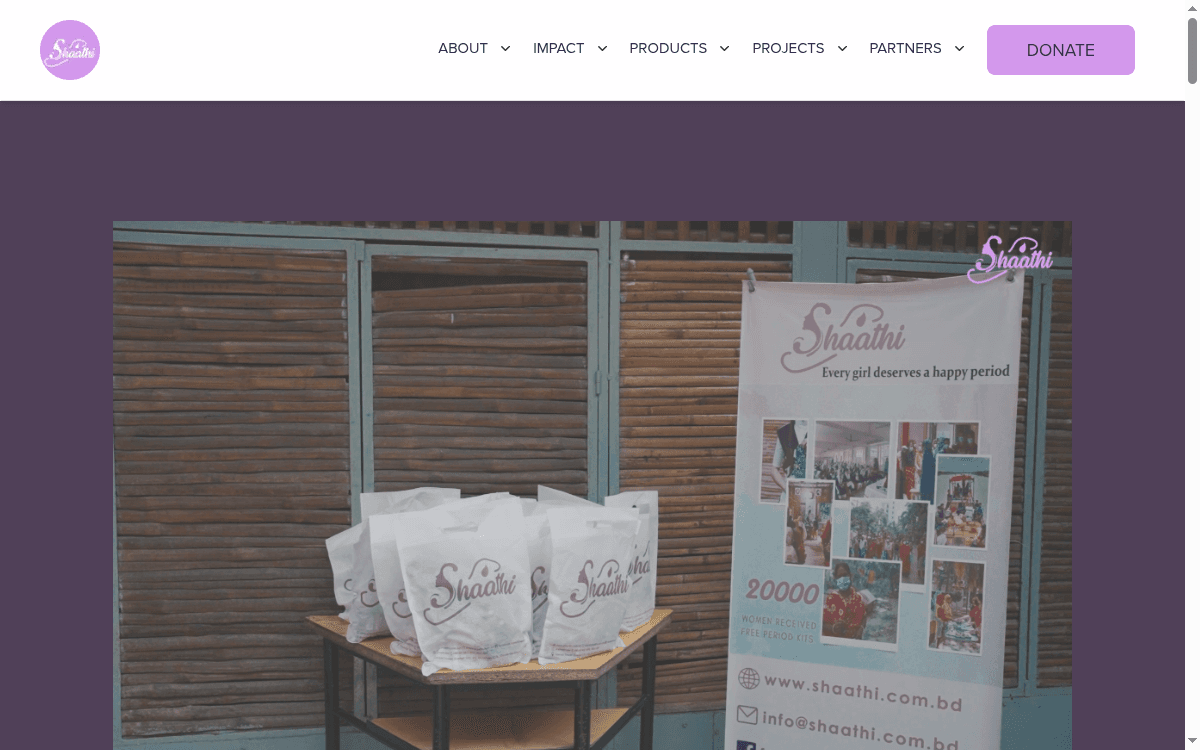
The problem
Roughly 89% of Bangladesh's female population cannot afford sanitary napkins. That statistic is the whole argument, and a site that buries it under a product catalogue fails the organisation. But Shaathi also genuinely sells three product lines and runs three distinct programmes, so a pure campaign site fails just as badly. The information architecture had to carry commerce and advocacy without either one flattening the other.
The approach
The narrative leads and the catalogue supports it: the scale of period poverty frames the landing experience, and the product lines — Shiuli, Jaba, and Shapla — appear as the concrete answer to it rather than as a storefront. Programmes get their own space so Safe Haven, economic empowerment, and health education can each be explained properly instead of compressed into one 'what we do' block. Everything is statically generated with optimised images, because a large share of the audience reads it on a mid-range phone over a mobile connection.
What it does
- Product pages for the Shiuli, Jaba, and Shapla reusable napkin lines
- Dedicated sections for the three programmes: Safe Haven pad bank, women's economic empowerment, and menstrual health education
- Impact storytelling across the eight divisions Shaathi operates in
- Statically generated pages with optimised imagery for mobile-first, bandwidth-constrained readers
- Structured metadata so the organisation's mission surfaces in search and answer engines
Stack
Outcome
Commerce and advocacy live on one site without either diluting the other
Programme work is explained in its own right rather than compressed into a single page
Fast on mid-range phones, which is where the audience actually reads it
References
Shaathi — questions
Common questions about Shaathi and how it was built.
Building something similar?
I'm open to new opportunities and project work.