Oporajita
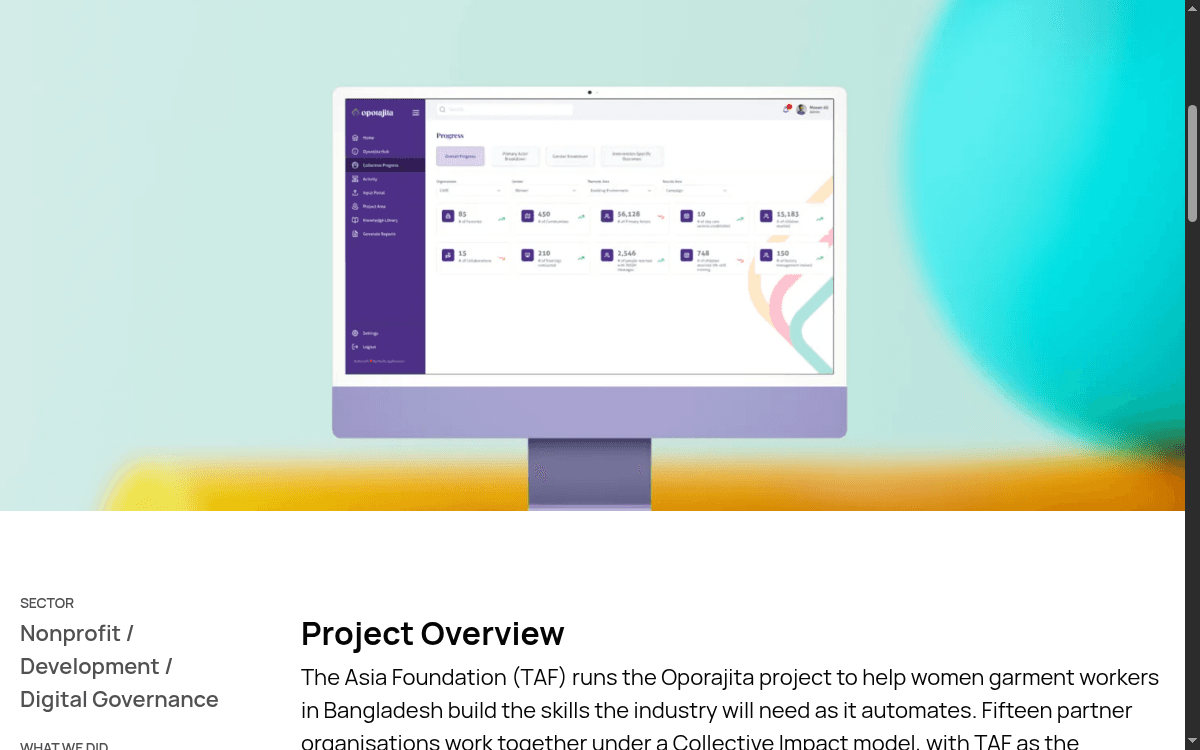
A programme management dashboard for the Oporajita initiative — a Collective Impact programme in Bangladesh's garment sector where 15 partner organisations work toward shared goals but had no shared view of them.
- Client
- The Asia Foundation
- Timeline
- 2025
- Role
- Frontend Engineer
- partner organisations
- 15partner organisations
- weeks, design to deployment
- 8weeks, design to deployment
- core capabilities
- 4core capabilities
Key takeaways
- Oporajita gives 15 partner organisations in Bangladesh's garment sector one standardised view of a programme they previously tracked in fifteen different spreadsheets.
- Standardising what partners submit makes cross-partner comparison a property of the system rather than a manual reconciliation step before every report.
- The Asia Foundation's Oporajita dashboard was delivered by ARITS Limited in an eight-week cycle running from UX design through deployment.
The problem
Every partner collected data differently, so no one could see the whole programme. Fifteen organisations meant fifteen spreadsheet conventions, fifteen reporting formats, and no way to answer a question about the initiative as a whole without a manual reconciliation pass. Donor reporting was slow and decisions rested on whichever partner's numbers happened to be at hand.
The approach
A service-oriented dashboard that standardises what partners submit and then makes the aggregate legible. Submissions run through one schema, so cross-partner comparison is a property of the system rather than an act of cleanup. On top of that sits a report builder for donors and project teams, a collaboration tracker that surfaces where partners are already working together, and an archive that keeps every historical submission reviewable rather than overwritten.
What it does
- Standardised dashboards giving every partner the same cross-programme view
- Report builder producing donor and project-team reports without manual collation
- Collaboration tracker surfacing joint activities across the 15 partner organisations
- Historical data archive — every submission stays reviewable rather than being overwritten
- Search-optimised analytics over document and relational stores with a caching layer
Stack
Outcome
Partners now work from one shared system instead of scattered spreadsheets
Achievements are monitored continuously rather than reconstructed at reporting time
Decisions rest on data the whole network can see
Delivered in an 8-week cycle from UX design through deployment
References
- Oporajita Web Application — case study — ARITS Limited
- The Asia Foundation
Oporajita — questions
Common questions about Oporajita and how it was built.
Building something similar?
I'm open to new opportunities and project work.